
【】
 我要评论
我要评论The U.S. had its second-warmest year on record in 2016, with every single state having a warmer-than-average year, according to a report released Monday by the National Oceanic and Atmospheric Administration (NOAA).
"The breadth of the 2016 warmth is unparalleled in the nation's climate history," NOAA scientists wrote in their annual climate report.
While records were toppled virtually everywhere, Alaska earned the title of having the most unusually warm year.
SEE ALSO:Obama says clean energy's momentum is 'irreversible,' even under TrumpAlaska, which is America's only Arctic state, had an average annual temperature of 31.9 degrees Fahrenheit, which was 5.9 degrees Fahrenheit above average. The state had its second-warmest winter, warmest spring, second-warmest summer and a warmer-than-average fall.
This wound up being the third straight warmest year on record in Alaska, where temperature records go back 92 years.
According to NOAA, Barrow, which is the northernmost city in the country, was 7.1 degrees Fahrenheit above average. For the first time in Alaska's climate record, its average spring temperature hit 32 degrees Fahrenheit, or 0 degrees Celsius.
 Annual average temperature departures from average in Alaska, showing the record high in 2016.Credit: noaa
Since 1925, Alaska has seen an average temperature increase of 0.30 degrees Fahrenheit per decade.
Nationally in 2016, the lower 48 states had an average annual temperature of 54.9 degrees Fahrenheit, which was 2.9 degrees Fahrenheit above the 20th century average. This ranks just behind 2012, when the annual average temperature was 55.3 degrees Fahrenheit.
Remarkably, 2016 marks the 20th straight year of above-average continental U.S. temperatures. Since 1895, NOAA found, the lower 48 states have observed an average temperature increase of 0.15 degrees Fahrenheit per decade.
Last year now ranks in at least the top seven warmest years on record for every state.
"No other year had as many states breaking or close to breaking their warmest annual average temperature," NOAA said in the report.
The year featured an extremely lopsided ratio between record highs and record lows, at 5.7-to-1. According to the nonprofit climate research and journalism group Climate Central, this is the highest such ratio since consistent records began in 1920. In particular, there were an unusually high number of overnight record warm overnight temperatures.
 2016 holds the record for the maximum extent in warm minimum temperature extremes, at 93 percent of the lower 48 states. The record footprint for cold maximum temperatures across the continental U.S. occurred in 1912 (58 percent) and in 1917 (74 percent) for extreme cold minimum temperatures.Credit: noaa
On a map of record warm overnight low temperatures, 2016's climate painted the country red, with 93 percent of the continental U.S. seeing warm minimum temperature extremes last year.
The average low temperature for the country was 43.1 degrees Fahrenheit, which beat the old record set in 2012 by about 0.2 degrees.
One measure of how unusual the climate of 2016 was in the U.S. can be found in NOAA's Climate Extremes Index, which keeps track of temperature, precipitation and other extremes. For 2016, this index was the third-highest on record, behind only 1998 and 2012. Record daytime highs and record warm overnight low temperatures were a major contributor to this high ranking, NOAA stated.
The climate of 2016 had links to El Niño, which waned in the spring, as well as human-caused global warming, which has been leading to an array of climate shifts in the U.S. including rapid warming in Alaska.
Last year, the U.S. experienced 15 weather and climate disasters with losses exceeding $1 billion, with a total of 138 fatalities, NOAA found. Of these billion dollar disasters, four were inland floods -- double the typical number of such events. NOAA has been keeping track of these types of costly disasters since 1980.
The U.S. temperature data precedes an anticipated announcement that 2016 was the warmest year on record globally, which is due on Jan. 18. The European Copernicus Climate Service has already found that 2016 broke a global record, but more data is still being analyzed.
Featured Video For You
Gov. Jerry Brown says California will build its 'own damn satellite' under Trump
相关文章

Dramatic photo captures nun texting friends after Italy earthquake
The image of an injured, bloodied nun, calmly texting friends and family in the wake of the deadly e2026-07-29
This is the best city for job seekers in 2017
If your goal for 2017 is to find a high-paying job in an affordable city, you may want to start your2026-07-29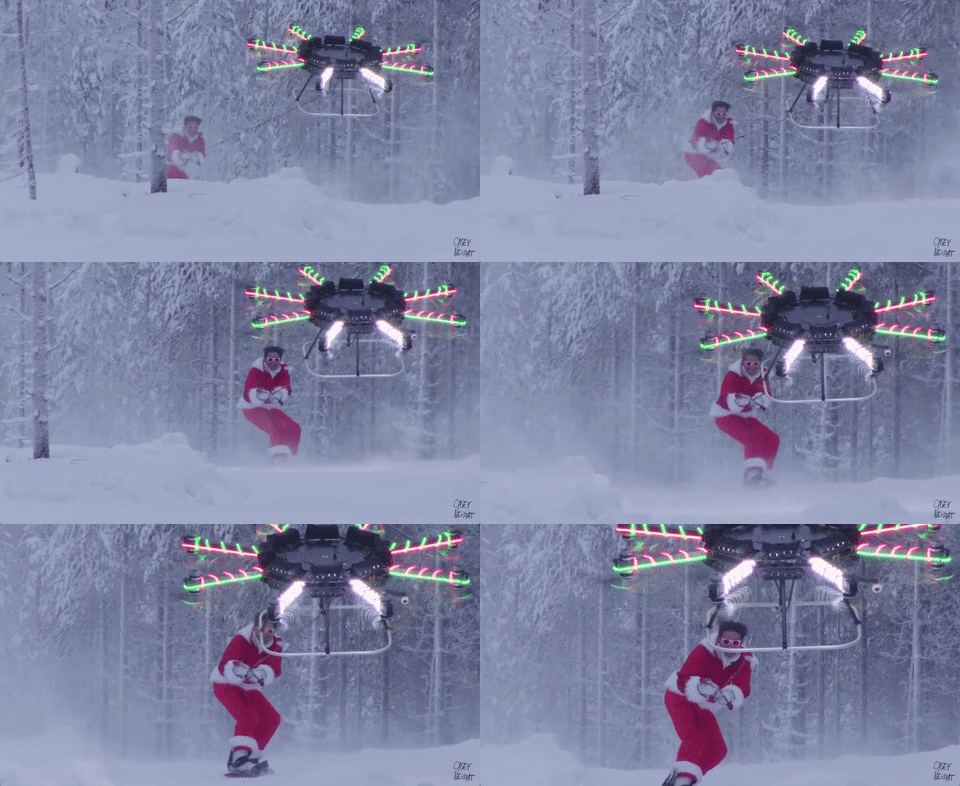
Watch a custom drone lift a dude on a snowboard off of a mountain
It's 2016, so obviously Santa's sleigh has been replaced with a drone.YouTuber turned CNN staffer Ca2026-07-29
Shake Shack now lets you skip the line and order on your phone
Shake Shack is finally shaking up the way we order food, while simultaneously working to eliminate l2026-07-29
These glasses hide a fitness tracker on your face
The last time a company tried popularizing wearable tech embedded in glasses, most notably with Goog2026-07-29
Redditors planning to hide hundreds of 3D
Let's play a game -- and include an entire city.That's the idea behind one Reddit post that proposed2026-07-29
最新评论