
【】
 我要评论
我要评论Picture this: A crew of the first humans to journey beyond Earth and the moon arrive at Mars. Their boots touch the rusty surface of the red planet after a months-long trip through deep space.
Who are they? How do they understand what they see? And what are the circumstances that sent them there?
These are questions that may seem like thought experiments for the distant future, but in truth, we need to confront them long before we send anyone to the red world.
SEE ALSO:Elon Musk shares the last image of his Tesla roadster floating through the solar systemAnd we should probably get to answering those questions soon.
Elon Musk wants to take us to Mars, and he could do it. His company SpaceX is inching ever-closer to building a rocket large enough to take humans out to the moon, Mars, and beyond, with the Big Falcon Rocket’s first flight to Earth orbit expected in the next 3 to 5 years.
The Trump administration also wants private companies to take over the International Space Station by around 2025, effectively ceding government control of a vital human spaceflight endeavor.
Musk claims that he wants to bring us out into the solar system for the good of humanity. A multi-planet species is a species that survives anything that threatens it, after all.
But what does Musk’s vision of humanity look like when mapped against the rest of the solar system? Who’s he going to bring out to space, and what does it say about us if we let him do it?
Shaping our view of a red world
Whoever gets to Mars first will forever change how we see that world.
Those first human eyes to look across the red planet in person will change how the rest of humanity encounters it. Is Mars a world of science, or a world of resources to exploit? That first human mission to the planet will likely decide the answer to that question.
 Mars seen from orbit.Credit: NASA/JPL/Malin Space Science Systems
Because of those high stakes, it's probably not the best idea to entrust the selection of the crew to capitalist forces. If we look at the exploration of Mars through a capitalist lens, then only the richest among us will be able to go to the red planet and what they do there will also be oriented toward profit-making.
If space exploration is for the good of us all, then we should make every effort to be sure that those we send out there reflect all of us.
But shouldn't we make sure that the first people to step foot on Mars represent the most diverse swath of humanity we have to offer?
In all likelihood, however, we won't get that diversity if we decide to just let billionaires have their run of the solar system.
In Musk’s mind, he hopes that one day seats aboard a ship bound for Mars will cost as much as an average home in the United States.
But that won’t be the case at first, and even when it is there are a lot of Americans who can't afford homes in the U.S., to say nothing of the rest of the world. People will need to spend millions and millions of dollars for a ticket to fly to Mars aboard SpaceX’s Big Falcon Rocket, meaning that, in theory, some of the first visitors to Mars could be some of the wealthiest people on Earth.
This comes amid an increasing consolidation of wealth and power among the upper echelon of society in the U.S., with billionaires taking over newspapers, the presidency, and increasingly, planning to extend their reach into outer space.
Our understanding of the planet -- what it looks like, how it feels to be there -- will change based on who gets there first. If the vast majority of people cannot relate to our first Martian explorers, then they won't be able to see themselves exploring the red planet.
If space exploration is for the good of us all, then we should make every effort to be sure that those we send out there reflect all of us.
While it’s also likely that NASA and other nations will want to buy seats aboard those first flights, that doesn’t change the fact that SpaceX will have the immense power of selecting who to send to Mars.
From the sublime to the ridiculous
Even if we ignore Musk’s long-term Martian ambitions, however, we already have some sense of what the billionaire entrepreneur envisions for our future in space.
Take, for example, his decision to send a Tesla Roadster loaded down with a mannequin named Starman to a distant orbit that will bring it not far from Mars. It’s fun, and weird, and in many ways, the exact opposite of how NASA sees its place in space.
 Starman aboard the Tesla.Credit: spacex
When NASA sent something of an art project to space with its Golden Record on the Voyager spacecraft in the 1970s, the agency spent months agonizing over what they would include on what was an unoccupied emissary of humanity. The Golden Record team eventually created a beautiful, sweeping amalgam of humanity in sound and photos, showing anyone who might happen upon it exactly what humanity is made of.
And instead SpaceX sent a car.
This would be a very different conversation if we could still depend on NASA to lead the way into deep space, but with politics as they are, NASA continues to get batted around by administrations that change goalposts on the agency every four to eight years.
Because of that, it seems unclear whether NASA will even send people to Mars before SpaceX gets there itself.
Learn from history, don't repeat it
While NASA isn’t perfect, at least it doesn’t award seats aboard its spacecraft to the highest bidder. For that reason alone, the idea that private visionaries could be our main point of access to an entirely new world is troubling.
Via GiphyMusk believes he wants to make space open for all to travel there, but how he goes about that is just as important as his vision of the future that got him to this point.
If we only send the richest among us – a small, self-selecting, and undiverse pool – to explore new worlds, then we would automatically set up a rigged system in favor of those who can buy favor within it.
We need to learn from our history, not repeat the faults of our ancestors by perpetuating that same kind of supremacy out into the universe.
This is by no means a new idea, but it’s true and bears repeating: Whatever we have on Earth we will also bring with us to space.
Space travel is one of the most important endeavors we've ever taken on as a society, and flying to Mars presents an unmatched opportunity to see ourselves reflected back at us from out there beyond anything we've ever known.
We should do everything possible to ensure that reflection matches the best possible version of ourselves?
We have extreme inequality on Earth: racism, misogyny, income inequality, and many other societal ills. It will take a conscious effort to avoid bringing these problems with us to the red planet, and somehow I doubt that Musk alone is up to that challenge.
Featured Video For You
This isn’t the first time Elon Musk made big promises
TopicsSpaceXElon Musk
相关文章

Nancy Pelosi warns colleagues after info hacked
House Minority Leader Nancy Pelosi warned fellow Democrats on Saturday to change their cellphone num2026-07-29
Dropping $500,000 to spend New Year's Eve with Justin Bieber is a good idea
If you love yourself, you will spend $500,000 for you and nine of your closest friends to spend New2026-07-29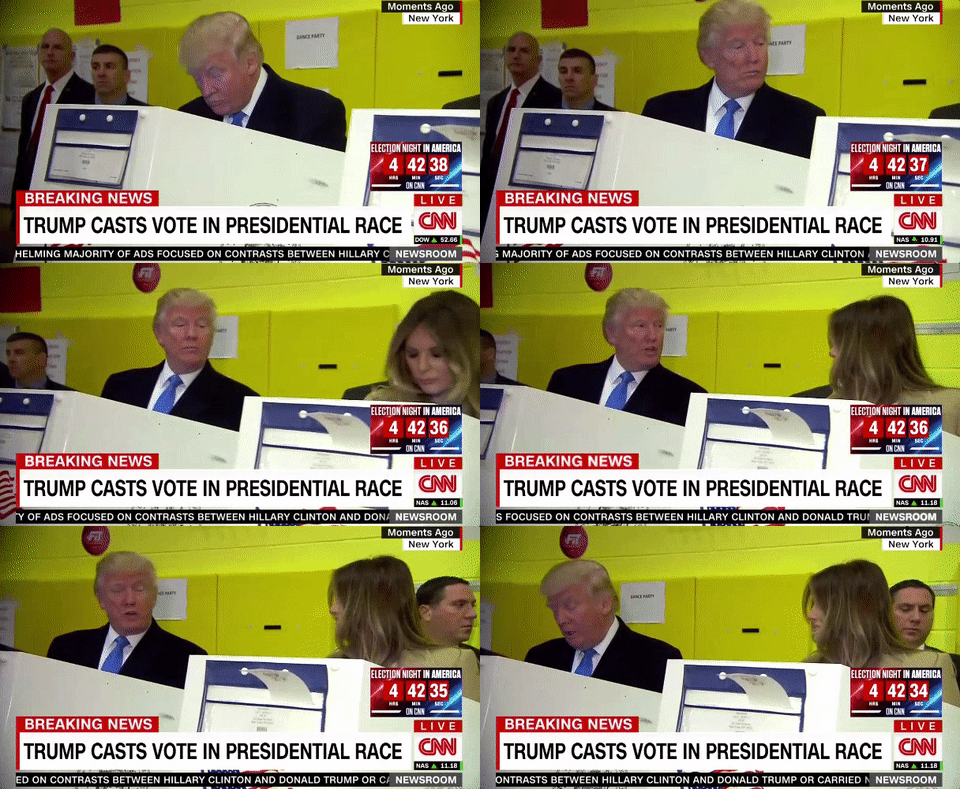
Donald Trump and Eric Trump both peeped on their wives' ballots
We're sure Donald Trump is confident that he has the vote of his wife Melania, noted Michelle Obama2026-07-29
Kid Cudi performed his first post
It's been a lot of days n' nites since anyone's seen Kid Cudi but to the delight of fans, the rapper2026-07-29
One of the most controversial power struggles in media comes to a close
One of the world's biggest media companies has been embroiled in a complex personal and professional2026-07-29
What will happen to 4 million dumped Samsung Note7s?
Samsung's busted Galaxy Note7 phone may have become a punchline, but 4.3 million dumped devices is n2026-07-29
最新评论